Monday, December 31, 2018

City Boy Book Review


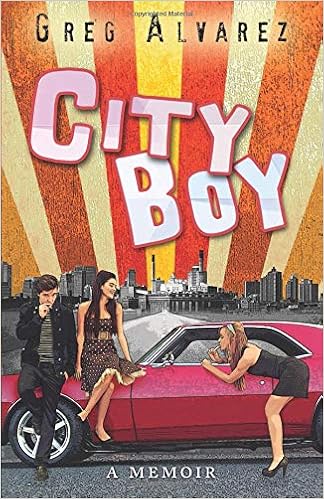
City Boy
by Greg Alvarez


The autobiography City Boy by Greg Alvarez captures the essence of his life from early teenage years to adulthood in an outrageously humous way. The book is a first-person narrative regularly addressing its audience directly in a colloquial, tranquil voice giving its reader a feeling of being in close proximity to the writer and the events unfolding in the story. 

Greg invites the reader into his crazy, funny life as his journey takes them back to the wild and carefree 1960s. It is full of entertaining stories, while giving the audience an insight into what it was like being young at that time. He is a rebellious, free-spirited youth with no interest in school. He is more concerned with having fun and hanging out with friends, while chasing girls, than crunching math problems. When Greg eventually leaves school, he sets out on his life’s journey.  

As Greg says, this is the lifestyle and awesome times that could not happen in today’s world simply because of how our world has changed. It is refreshingly nostalgic, though that in itself may be a contradiction, to be brought back several decades and introduced to a time when hitchhiking did not necessarily put your life in terrible danger. We are brought to a time when you didn’t risk getting shot by the police because you got caught with a water bong in your possession. Refreshingly, it is also an era when political correctness did not kill society and plain old good times. 

It is hard to point to just one favorite story in City Boy but one that surely made me literally cry from laughing too much was his story about crashing into a Marine’s car. His description of the event is priceless. Likewise, is his description of his boss’ Italian accent and behavior when Greg worked at a Pizzaria. Through his own charming narration, Greg adds richness and character to his life story. Additionally, we are taken on a good, old American trucker’s journey with all it entails.  

Although names have been changed, we meet Greg’s family, friends, coworker’s, lovers, girlfriends and wife through the events that shaped him from a young kid, to a rebellious teenager, and finally to an experienced adult.  

City Boy is full of sex, drugs, and free-spirited times. However, on a more serious note, Greg enters an interesting discussion of his perspective on the differences between men and women, and how they think differently. Greg openly discusses how he thinks men, contrary to women, often, if not always, distinguishes between sex and love, whereas women tend to equate the two with one another. His frankness about sexuality and testing our boundaries breaks with political correctness, which he argues permeates society, as if it is the only way to rightfully view ourselves and each other. Greg has the guts to openly discuss the topic from a man’s perspective, however with the ability to also see things from a woman’s perspective. 

City Boy is not book, as Greg also says, for the prudish, sex-phobic audience. It is a book for those who have not yet been lost to dull, modern day political correctness. It is a book for the mature audience with a open-minded sense of humor. 

I much enjoyed the read, and would look forward to any other book that Greg Alvarez may write in the future. 

City Boy is available on Amazon as eBook and paperback. 


Published: 2017
Publisher: Independent Publishing 

Sunday, December 30, 2018


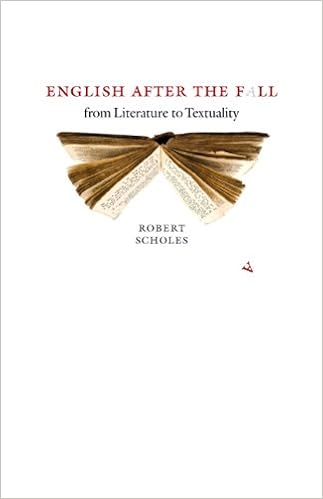
English After the Fall 
By Richard Scholes 


Research Professor Robert Scholes’ English After the Fall: From Literature to Textuality (2011) is a 176-page book written for students and academics. Scholes is also known for his now classic, Rise and Fall of English.

English After the Fall is concerned with how English departments have become stuck in its old ways of reading, and writing, text. He charges that academics and scholars have become a narrow study and begs the need to reconsider a broader purpose of English studies providing university educators with improved tools to help students think critically when interpreting a text and to use textuality in reading and writing studies to improve study methodology.

As many English departments in the United States, where Scholes lectures, as well as other parts of the world, have become increasingly smaller, his book is released at the right time calling for an expansion of perspectives, study methods, and cross-studies. He argues that reading English involves writing English and vice versa, and argues that texts must be considered as being more than merely classic, literature studies.

Scholes encourages the usage of a broad range of texts – textuality – in university English departments arguing that the study of literature should encompass reading as well as writing. The book provides numerous examples, supporting Scholes’ thesis, to demonstrate how textuality works beneficially in English studies. It argues that the barrier between teaching literature and teaching writing composition must be broken down in today’s age of technology, as the drop-in humanities studies is reflected in the exponentially progressing use of technology. Scholes laments that the academic world is “constrained” to antiquated notions of literature that ignores other important text types.

Scholes supports his thesis, and the book’s title, with examples such as the need to read poems from a contextual ankle, such as reading Wordsworth from the perspective of the real problems that colored Wordsworth’s late nineteenth century world. He argues that literariness ought to be a “combination of textual pleasure and power.” Likewise, he exemplifies with the John Ford movie The Man Who Shot Liberty Valance (1962) where the protagonist uses different texts to teach reading to illiterate students. Scholes argues for the movie, as an example of how beneficial textuality usage is, that any text type must be interpreted and responded to critically, and not just at face value, to be properly and justly understood. Modern students of English must reach, interpret, reflect and criticize texts contextually and must include other types of texts in the discourse analysis, from primary and secondary sources to poems and even operas.

Conclusively, English After the Fall interprets and reflects on sphere of texts that students of English as well as their educators should consider when studying not only reading but also writing. It pleasantly provokes old, ingrown ways of studying English to rise up to the twenty-first century to encompass textuality. The only thing it does not directly address is that English studies are still to fully catch up with is contextuality where a combination of English literature, history and social studies is more thoroughly combined in some universities, as is the case in some European universities.  

English After the Fall by Robert Scholes was published in 2011 by University of Iowa Press, Iowa City, IA, USA. ISBN: 978-1-60938-055-7. English After the Falls is available in paperback on www.Amazon.com.

Sakuntala af Gert Maarløv Nikolajsen

Titel:                 Sakuntala Forfatter:         Gert Maarløv Nikolajsen Udgivelsesår:  2019 Forlag:              Forlaget mellemgaard...