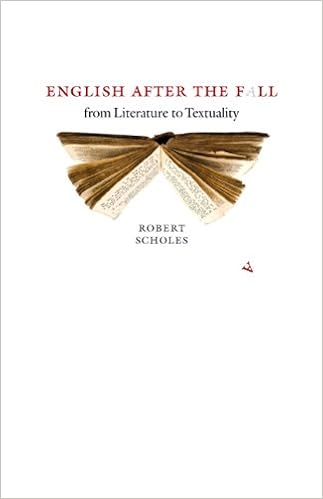
English After the Fall
By Richard Scholes
Research Professor Robert Scholes’ English After the Fall: From Literature to Textuality (2011) is a 176-page book written for students and academics. Scholes is also known for his now classic, Rise and Fall of English.
English After the Fall is concerned with how English departments have become stuck in its old ways of reading, and writing, text. He charges that academics and scholars have become a narrow study and begs the need to reconsider a broader purpose of English studies providing university educators with improved tools to help students think critically when interpreting a text and to use textuality in reading and writing studies to improve study methodology.
As many English departments in the United States, where Scholes lectures, as well as other parts of the world, have become increasingly smaller, his book is released at the right time calling for an expansion of perspectives, study methods, and cross-studies. He argues that reading English involves writing English and vice versa, and argues that texts must be considered as being more than merely classic, literature studies.
Scholes encourages the usage of a broad range of texts – textuality – in university English departments arguing that the study of literature should encompass reading as well as writing. The book provides numerous examples, supporting Scholes’ thesis, to demonstrate how textuality works beneficially in English studies. It argues that the barrier between teaching literature and teaching writing composition must be broken down in today’s age of technology, as the drop-in humanities studies is reflected in the exponentially progressing use of technology. Scholes laments that the academic world is “constrained” to antiquated notions of literature that ignores other important text types.
Scholes supports his thesis, and the book’s title, with examples such as the need to read poems from a contextual ankle, such as reading Wordsworth from the perspective of the real problems that colored Wordsworth’s late nineteenth century world. He argues that literariness ought to be a “combination of textual pleasure and power.” Likewise, he exemplifies with the John Ford movie The Man Who Shot Liberty Valance (1962) where the protagonist uses different texts to teach reading to illiterate students. Scholes argues for the movie, as an example of how beneficial textuality usage is, that any text type must be interpreted and responded to critically, and not just at face value, to be properly and justly understood. Modern students of English must reach, interpret, reflect and criticize texts contextually and must include other types of texts in the discourse analysis, from primary and secondary sources to poems and even operas.
Conclusively, English After the Fall interprets and reflects on sphere of texts that students of English as well as their educators should consider when studying not only reading but also writing. It pleasantly provokes old, ingrown ways of studying English to rise up to the twenty-first century to encompass textuality. The only thing it does not directly address is that English studies are still to fully catch up with is contextuality where a combination of English literature, history and social studies is more thoroughly combined in some universities, as is the case in some European universities.
English After the Fall by Robert Scholes was published in 2011 by University of Iowa Press, Iowa City, IA, USA. ISBN: 978-1-60938-055-7. English After the Falls is available in paperback on www.Amazon.com.


No comments:
Post a Comment
Thank you for your comments